
Hot Springs Directory Shelves
The historical shelf begins earlier than the main local run. A combined Caron & Co. volume covered Hot Springs in 1876–77, Sholes published a directory in 1883–84, and Spring's appeared in 1887. The Garland County Historical Society holdings describe local directories from 1887 forward. Its telephone books begin in 1903. The shelf is not one neat, unbroken digital series, so a year, title page, and repository should be recorded with every finding.
| Collection | Years | Where Held | Access |
|---|---|---|---|
| Named early directories | 1876–77, 1883–84, 1887 | FamilySearch Library and large genealogy collections | Catalog or repository access |
| Local directory run | 1887–present, as stated in holdings | Garland County Historical Society | Research library; confirm hours |
| Published volume sequence | 1903 through 1960, with listed gaps | Allen County Public Library and cataloged collections | Repository or licensed database |
| Telephone directories | 1903–present in holdings description | Historical society; some 1934–55 scans at Library of Congress | In person and selected digital scans |
| Maps and Sanborn sheets | 1890 through 1945 in seven documented years | GCHS, Library of Congress, and NPS references | Mixed reading-room and digital access |
The dated published sequence includes 1903, 1905–06, 1908, 1910, 1912, 1915, 1917, 1921, 1923, 1926, 1928, 1930, 1935, 1938, 1940, 1942, 1944, 1946–47, 1949, 1951, 1953, 1955, 1957–58, and 1960. A missing year in that list does not prove no book was printed. It means the inspected catalog did not establish one. Never assign a publisher to a later volume unless its title page confirms the claim.
Hot Springs Directory Archive Center
The historical society at 328 Quapaw Avenue is the core archive for local directory work. Beyond the directory run, it holds newspapers, manuscripts, maps, books, original death books, vertical files, and a searchable database reported to contain more than 40,000 photographs and items. Family, organization, neighborhood, Chamber of Commerce, Garden Club, mayoral, State Fair, and Dr. Francis J. Scully files can place a directory name in local context.
The Garland County Historical Society site supplies its current contact route. Earlier descriptions list 501-321-2159 and weekday-morning research hours, but those hours should be confirmed before a visit. Ask whether a volume is on the shelf, microfilm, or in staff retrieval. Also ask whether a named group roster or newsletter is open before relying on it.
The historical society source page for the collection can be previewed below.
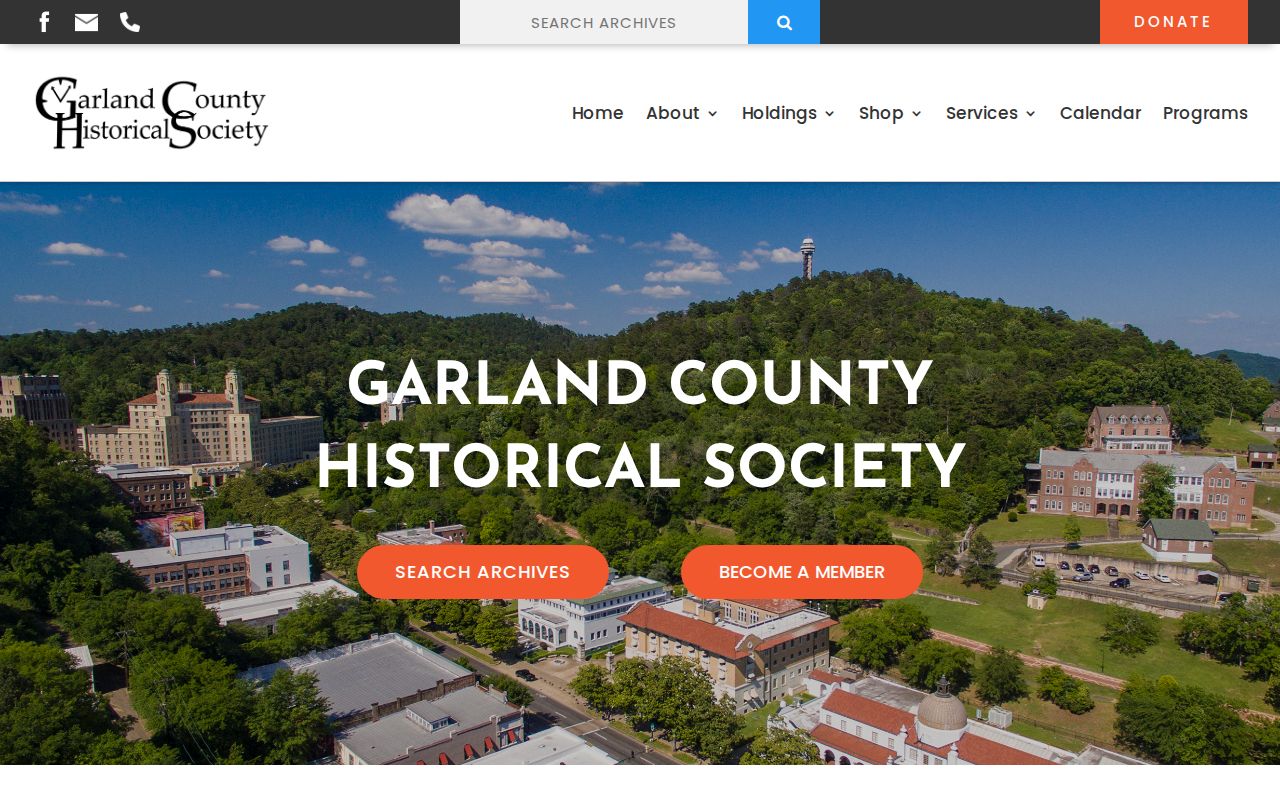
The society screen is the practical gateway to the deepest Hot Springs directory holdings and the related files that explain an otherwise spare printed entry.
Note: Distinguish Garland County from Hot Spring County when searching catalogs, since the similar names can send research to the wrong county.
Where Hot Springs Directories Moved
The public library remains a useful first contact, but it is not the only shelf. Many genealogy and local-history materials moved from the Garland County Library to the historical society in 2014. That transfer explains why a broad library search may appear thin even though strong local material survives nearby. The Garland County Library adult resources desk, at 1427 Malvern Avenue and 501-623-4161, can identify current database access and refer researchers to the society or Arkansas State Archives.
The library's official resources page appears in this captured view.

The screen reinforces the best fallback chain: check current library subscriptions, then ask the historical society for deep local holdings and the Arkansas State Archives for state and county material.
Decode Hot Springs Directory Entries
An 1887-derived entry can contain a surname, initials or given name, occupation, place of business, and a residence or boarding place. Trades such as clerk, barber, porter, and blacksmith appear in the surviving local index. That detail is vital in a resort city where hotels, bathhouses, medical offices, and seasonal stays brought many people through town. An entry can establish where someone was listed at canvass time. It cannot, by itself, establish ownership or a long stay.
| Name | Surname with initials or given name; later volumes may include a spouse in parentheses. |
|---|---|
| Trade | Occupation and sometimes the business street or place of work. |
| Address phrase | Residence, rooms, boarding place, or neighborhood wording such as South Hot Springs. |
| Household clue | Spouse, widow notation, or other adult listed at the same address. |
| Street clue | A reverse section, when present, arranges entries by street and house number. |
Read the front matter first. Abbreviations can vary by year, and survey dates may precede the date printed on the cover. The later shorthand commonly includes wid for widow, h for home, and r for residence or rooms, but each book's own key controls.
- Criss-cross directory
- A later address-first section that groups listings by street rather than surname.
- Householder index
- An address-oriented list of the named person associated with each listed household.
- Abbreviation key
- The volume's guide to its marks and shortened words; copy it before interpreting entries.
- Canvass date
- The time when names were gathered, which may be earlier than the publication year.
Hot Springs Directory Milestones
The publication trail tracks major changes in local record keeping. It also crosses a county boundary problem. Garland County formed in 1873 from parts of Hot Spring, Montgomery, and Saline counties, so an earlier family may appear under a predecessor jurisdiction or federal Hot Springs Reservation records rather than a Garland volume.
| Year | Directory or record milestone |
|---|---|
| 1876–77 | Caron & Co. included Hot Springs with Little Rock and Pine Bluff. |
| 1883–84 | Sholes issued an early structured directory. |
| 1887 | Spring's volume begins the local run described by GCHS. |
| 1903 | Telephone-directory coverage begins in the holdings description. |
| 1950 | Latest named federal census currently public under the 72-year rule. |
| 1960 | A directory year in the published sequence; the 1960 census is expected in 2032. |
This sequence gives a sound frame, not a claim that each year survives. Record the actual volume title, date, publisher, repository, and page. For pre-1873 work, search predecessor counties and state or federal archives.
Hot Springs Directories Bridge 1890
The loss of most 1890 federal population schedules makes local sources unusually important. Hot Springs can fill parts of that gap with directories, 1892 voter evidence, deeds, newspapers, original death books from 1898–1923, an 1890s jail register, and early police dockets. These sources do not all mean the same thing. A voter list marks registration, a deed names a legal party, and a custody register should never be treated as proof of residence.
Historical society newspaper holdings include 1909–1949 microfilm and other print material. Obituaries, legal notices, social columns, and address-based advertisements can explain why a name vanished between volumes. A disappearance may mean a move, death, changed spelling, skipped canvass, or a choice not to be listed. Keep each explanation open until a second source closes it.
Hot Springs City Cemetery adds another path. The official City Cemetery history traces the site to a smallpox pest house in 1895 and a public cemetery added in November 1896. It includes unmarked graves and people described as visitors who died while seeking care.
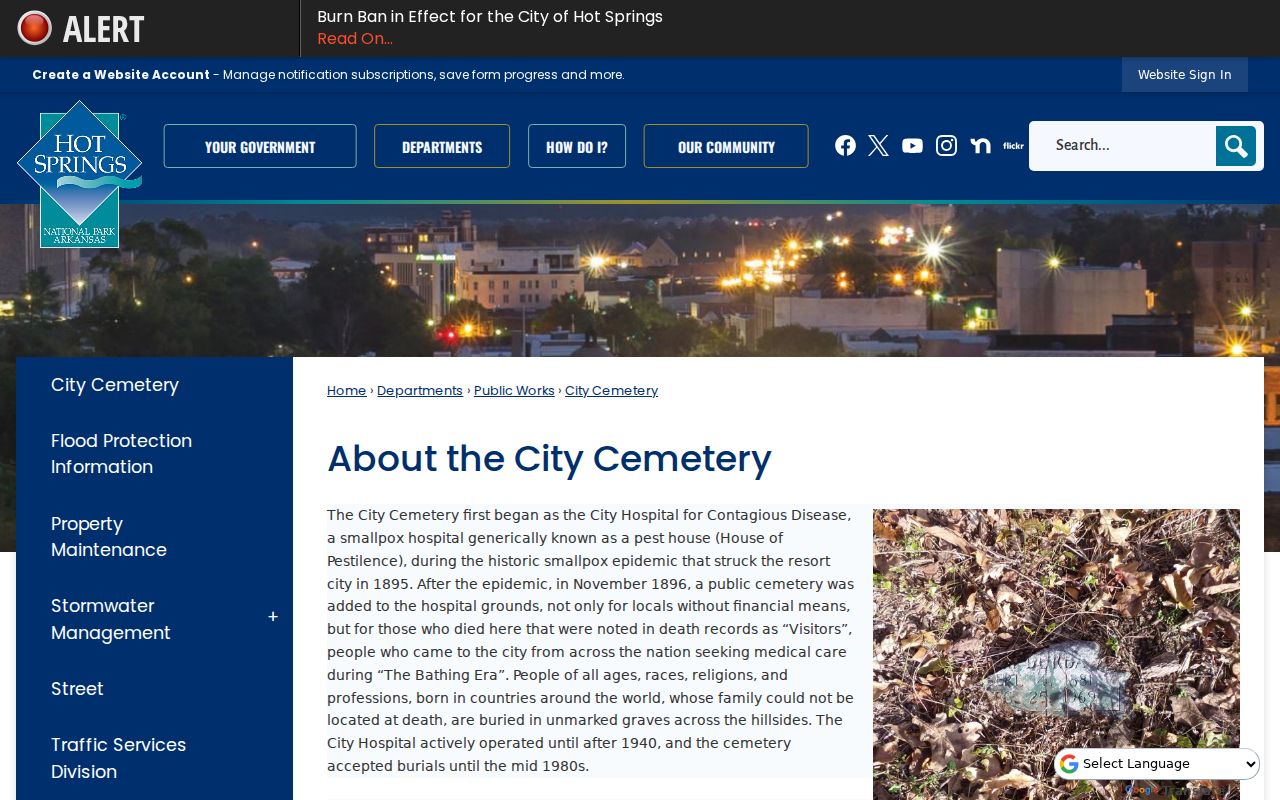
The cemetery view helps turn a directory disappearance into a carefully sourced death or burial lead, especially during the city's medical and bathing era.
Map Hot Springs Directory Addresses
A name-first listing works best when paired with the building itself. Documented Sanborn map years include 1890, 1896, 1901, 1908, 1915, 1925, and 1945. The Library of Congress Sanborn collection can show a structure's footprint, material, use, number, and additions. It does not identify the occupant. The dated listing supplies the person, a deed supplies the owner, and a census supplies household relationships.
Pleasant Street research offers a strong local model. Historic-district work pairs parcel identifiers with directory years and census evidence. Central Avenue and Bathhouse Row may also intersect federal park and commercial records. Those local layers matter because “Hot Springs National Park” can be a postal label as well as a place.
Note: A printed address is evidence to reconcile, not a guarantee that a modern number identifies the same structure or parcel.
Trace Hot Springs Family Directories
Family history is strongest when the search moves one year at a time. Start with a known name and date. Capture the full entry, not just the address, then compare the next available book for moves, spouse wording, initials, trade, and other adults at the same place. A directory appearance begins “by the survey date,” while an absence has several possible causes.
- Find the first known alphabetical entry and copy the title page, year, abbreviation key, page, and full listing.
- Move through nearby directory years, testing initials, full names, former surnames, and spelling variants.
- Check the reverse or street section when available, then note adjacent listings without assuming they are relatives.
- Pair the nearest directory with the 1900 through 1950 public censuses to compare household relationships.
- Use deeds for ownership, then newspapers, probate, death books, or cemetery records to explain a trail's end.
A current identity question may need official records rather than more archive work. The Hot Springs resident lookup shows how to verify a name across present-day custodians. For the historical trail, preserve every source's role and date. That prevents a hotel guest, boarder, business contact, property owner, and long-term resident from being merged into one person.